
Testing your water is what separates an aquarium that thrives from one that merely survives. No measurement means no diagnosis — and no diagnosis means no action. This AQUARIOPURE® guide gives you the target values, the ideal testing frequency and the right tools for both freshwater aquariums and reef / marine aquariums.
Why test your water regularly?
An aquarium is a closed ecosystem in which every chemical parameter directly affects the health of fish, invertebrates and plants. Imbalances usually take hold before any visible signs appear (listless fish, algae blooms, coral bleaching). Testing allows you to:
- Anticipate problems — a rise in NH3 or NO2 is the first warning sign of a disrupted biological cycle.
- Validate the start-up cycle — 4 to 6 weeks of daily monitoring are needed to establish the bacterial colony.
- Optimise water changes — there is no point changing 30% if KH and NO3 are spot on. Test before you act.
- Monitor remineralisation of AQUARIOPURE® RO water so that it matches the needs of your species.
- Diagnose problems — dull colours, corals that stop growing, fish dying for no visible reason: a test often reveals the cause.
Parameters to test — freshwater aquarium
| Parameter | Target range | Frequency | Recommended tool |
|---|---|---|---|
| pH | 6,8 - 7,8 | 1× / week | PH-02 Water Analyzer |
| KH (carbonate hardness) | 4 - 8 dKH | 1× / week | KDI-DSK-IKT017 drop test kit |
| GH (total hardness) | 6 - 12 dGH | 2× / month | KDI-DSK-IKT001 TH kit |
| NH3 / NH4 (ammonia) | 0 mg/L | 1× / week + during cycling | Colorimetric kit |
| NO2 (nitrite) | 0 mg/L | 1× / week + during cycling | Colorimetric kit |
| NO3 (nitrate) | < 25 mg/L | 1× / week | Test strips or drop kit |
| PO4 (phosphate) | < 0.1 mg/L | 2× / month | HANNA HI713 Checker |
| TDS | varies by species | 1× / week | TDS-3 or TDS A2 |
| Temperature | 22 - 26 °C | Daily | Thermometer / MS-01 |
💡 Special cases
Caridina shrimp : KH 0-2, GH 4-6, TDS 80-180 ppm. Highly sensitive to nitrate — keep below < 10 mg/L.
Discus / Amazon biotope : pH 5.5-6.5, KH 1-3, TDS 50-150 ppm.
African cichlids : pH 7.8-8.5, KH 10-18, TDS 400-600 ppm.
Parameters to test — reef / marine aquarium
| Parameter | Target range | Frequency | Recommended tool |
|---|---|---|---|
| Salinity | 33 - 35 ppt (density 1.024-1.026) | 1× / week | Refractometer or TDS A2 |
| pH | 8,1 - 8,4 | 1× / week | HANNA HI780 |
| KH / Alkalinity | 7 - 10 dKH | 2× / week | HANNA HI755 Checker |
| Calcium (Ca) | 400 - 450 mg/L | 2× / week | HANNA HI758 Checker |
| Magnesium (Mg) | 1250 - 1350 mg/L | 1× / week | HANNA HI783 |
| NH3 / NH4 | 0 mg/L | 1× / week | HANNA HI784 |
| NO2 | 0 mg/L | 1× / week | Colorimetric kit |
| NO3 | < 5 mg/L | 1× / week | HANNA HI781 Checker |
| PO4 | < 0.03 mg/L | 1× / week | HANNA HI713 Checker |
| Mg hardness | softener check | Monthly | HANNA HI719 |
| Temperature | 24 - 26 °C | Daily | Thermometer / MS-01 |
⚠️ In reef tanks, precision is vital
A shift of 0.1 pH or 20 mg/L of Ca can bleach your SPS corals within 24 hours. Drop test kits are not accurate enough for high-end reef keeping: opt for HANNA Checker HC mini photometers for reproducible optical precision.
Our equipment recommendations by profile
Beginner / freshwater community aquarium
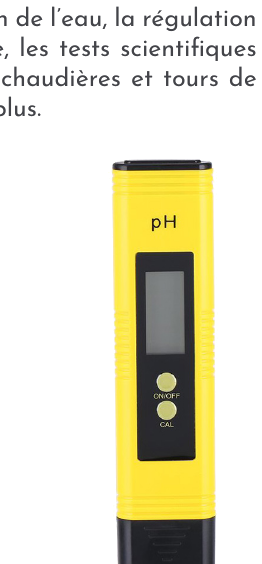
PH-02 + DROP TEST KITS
A PH-02 Water Analyzer pH meter + TH kit + colorimetric nitrate/ammonia kit cover the essentials for under €100.
View the range →Intermediate aquarist / demanding planted tanks
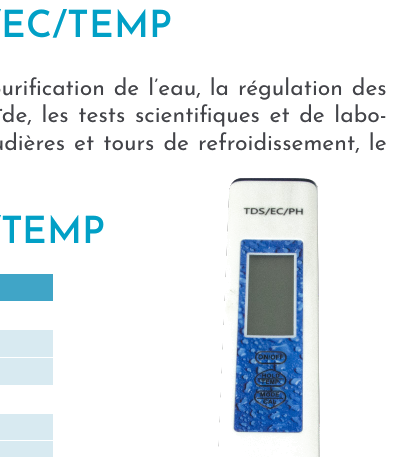
MS-01 4-IN-1
pH + TDS + EC + temperature in a single instrument. Ideal for monitoring remineralised RO water and a healthy biological cycle.
View the product →Reef / marine — professional set-up
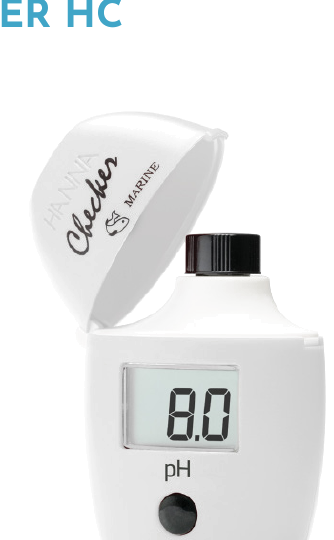
HANNA CHECKER HI780
Optical pH meter dedicated to saltwater, 0.1 pH resolution. Pair it with the HI783 (Mg), HI784 (ammonia), HI755 (KH) and HI758 (Ca).
View the product →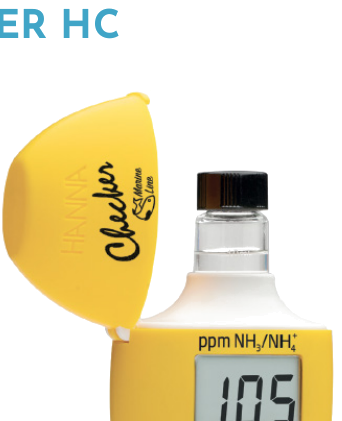
HANNA CHECKER HI784
Ammonia mini photometer (NH3/NH4) for saltwater. 0.01 mg/L resolution — detects the slightest drift before it affects your reef fish.
View the product →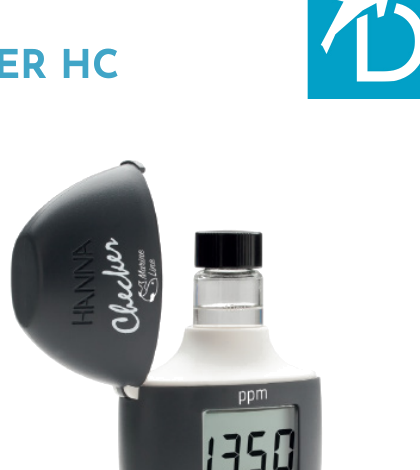
HANNA CHECKER HI783
Measures Mg²⁺, essential to coral growth (1000-1800 mg/L). EDTA calmagite method, ±5% accuracy.
View the product →Method: how to test correctly in 6 steps
- Sample from the right place — mid-depth in the aquarium, never at the surface (gas exchange zone) or at the bottom (sediment zone). Use a clean vial free of soap residue.
- Mind the temperature — chemical reactions vary with temperature. All our kits are calibrated for 20-25°C. For a rigorous test, let the sample settle to temperature for 5 minutes.
- Follow the protocol exactly — number of drops, shaking time, resting time. A rushed test gives false readings. HANNA mini photometers are designed to minimise human error (single button).
- Test in the right order — start with the "routine" parameters (pH, KH, NO3), then the specific tests (NH3, PO4, Ca, Mg). Ammonia reagents are the most sensitive to contamination.
- Record your results — a logbook (paper or app) lets you spot trends, not just one-off values. For example, a pH dropping by 0.1 per week points to a falling KH.
- Store reagents properly — away from light and heat, between 10 and 25°C. AQUARIOPURE® calibration buffer solutions have a shelf life of 1 to 2 years unopened.
Recommended maintenance and testing schedule
| Frequency | Action |
|---|---|
| Daily | Visual inspection, temperature check, filtration check |
| Weekly | Test pH, KH, NO3, NH3. Water change of 10-15% with remineralised RO water. |
| Twice monthly | Test GH, PO4, TDS. Clean the glass + siphon the substrate. |
| Monthly | Full test panel (reef: in-depth Ca, Mg, KH). Rinse filter foams. |
| Quarterly | Calibrate the pH meter. Check pumps and heating. |
| Every six months | Replace AQUARIOPURE® RO unit sediment + carbon cartridges. |
| Annually | General check: replace expired reagents, full parameter review, RO membrane test. |
Common mistakes to avoid
- Only testing when "something is wrong" — too late. A four-week trend tells you far more than a single isolated reading.
- Relying on a single test — an unexpected result? Repeat it with different reagents or another instrument before you panic.
- Mixing reagent brands — every manufacturer uses its own concentrations. Stay consistent (e.g. a complete HANNA range).
- Testing straight after a water change — wait 24 hours for the aquarium to stabilise, otherwise the readings will be distorted.
- Forgetting to calibrate the pH meter — an uncalibrated PH-02 drifts by 0.2-0.5 pH over 3 months.
- Storing reagents in sunlight or heat — accelerated degradation and false readings. Keep them in a cool, dark cupboard.
- Using expired tests — always check the date on the label. An expired test gives unusable results.
Frequently asked questions — water testing
As a routine, once a week for pH, KH, NO3 and NH3. During the start-up cycle (first week), test NH3 and NO2 daily. In a reef tank, Ca, Mg and KH should be monitored 2-3 times a week.
Yes, considerably. Drop test kits rely on the human eye (colour comparison). A HANNA Checker HC mini photometer measures optically to an accuracy of 5% or better, with no subjective error. Essential for demanding reef aquariums.
TDS (total dissolved solids) reflects overall mineral content. It is useful for checking the purity of RO water (< 10 ppm), monitoring evaporation in a reef tank (rising TDS = concentrated salts) and fine-tuning remineralisation for shrimp or discus.
Yes, and it is exactly what you want. In a mature aquarium, nitrifying bacteria immediately convert NH3 → NO2 → NO3. A reading > 0 mg/L points to an underperforming biological filter or overstocking.
Use AQUARIOPURE® calibrated buffer solutions (pH 4, 7, 10, ref. KDI-DSK-ITP005 etc.). The PH-02 and MS-01 offer automatic 2-point calibration. Recalibrate every 1-3 months depending on use.
Yes, and it is recommended from day 2 onwards. Follow the ammonia curve, then nitrite, then nitrate — that progression is the sign of an established biological cycle. Do not add any fish until NH3 and NO2 remain stable at 0 mg/L (4-6 weeks).
Yes, through the HANNA Instruments® and Water Analyzer ranges distributed by the DIMM group. Browse our HANNA catalogue online or contact us for a quote.
Unsure about a parameter? We will guide you.
Our AQUARIOPURE® experts help you choose the right tests for your aquarium and interpret your results.
Request free advice